
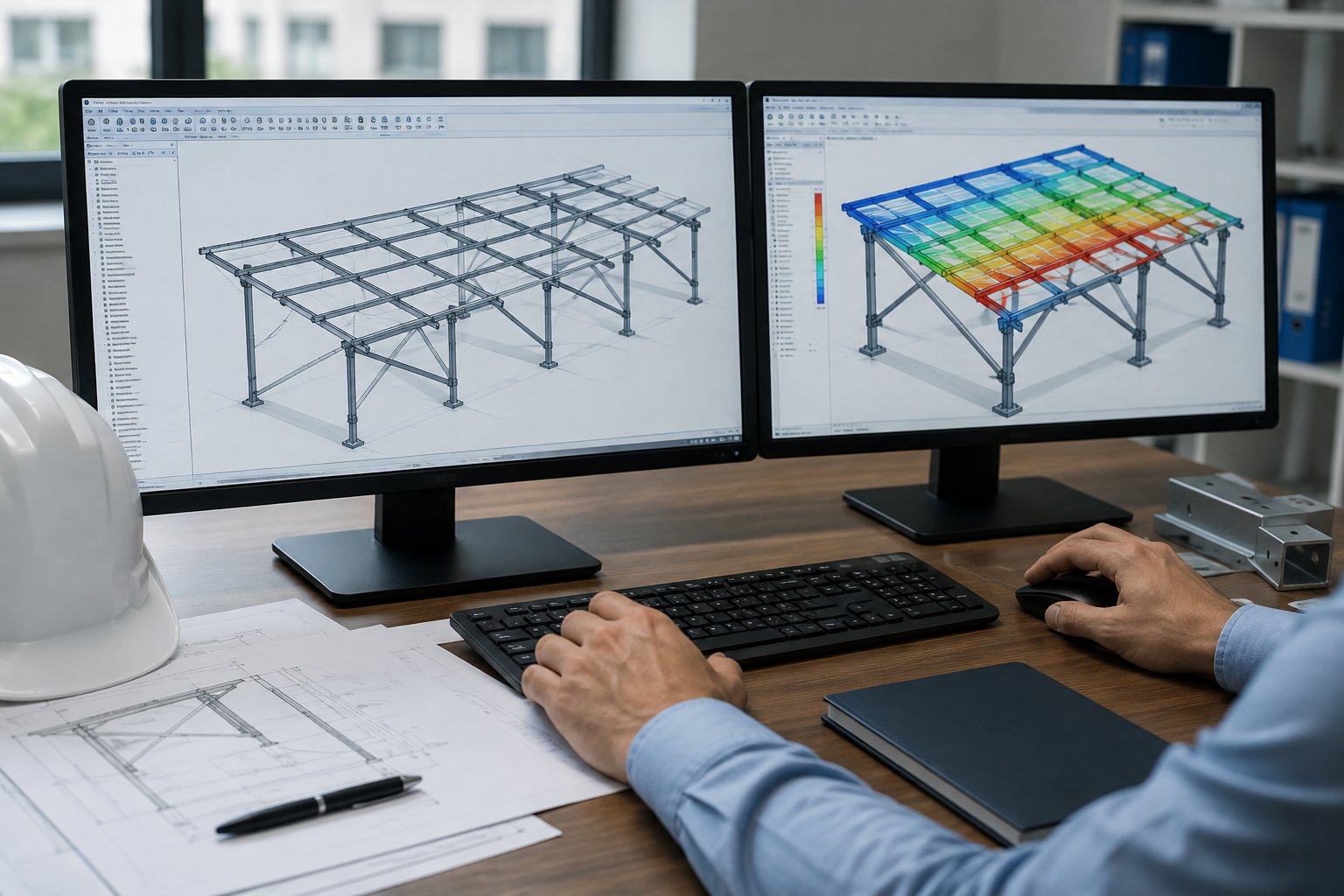
Selecting high-quality solar panels and inverters is only part of developing a reliable photovoltaic project. The solar mounting system supporting the modules also plays a critical role in structural safety, installation efficiency, maintenance requirements and long-term project performance.
An improperly selected PV mounting system may lead to installation difficulties, unnecessary material usage, higher field labor, corrosion risks and structural performance issues. For this reason, solar structure selection should be based on project-specific engineering requirements.
In this guide, we examine the most important factors to consider when selecting a solar mounting system for PV projects, from ground conditions and environmental loads to profile geometry, corrosion protection, installation efficiency and manufacturing quality.
Why Is Solar Mounting System Selection Important?
A solar mounting system is the primary structural framework that supports photovoltaic modules throughout the lifetime of the project.
The structure does more than hold the panels. It positions them at the required inclination, transfers environmental loads safely and supports an efficient installation process.
A properly designed system can help:
- Improve structural reliability,
- Reduce installation time,
- Optimize material usage,
- Improve corrosion protection,
- Simplify maintenance operations,
- Support long-term project performance.
1. Determine the Correct Application Type
The first step in selecting a solar mounting solution is identifying the type of photovoltaic installation.
Common applications include:
- Ground-mounted solar systems,
- Flat roof mounting systems,
- Pitched roof solar systems,
- Solar carport structures,
- Project-specific mounting solutions.
Each application has different structural requirements. Ground-mounted projects focus heavily on foundation and soil conditions, while rooftop projects may require greater attention to roof capacity and protection of the existing building envelope.
2. Evaluate Ground Conditions Carefully
For ground-mounted photovoltaic projects, soil conditions are among the most important factors influencing mounting structure design.
Ground conditions may affect:
- Driven pile suitability,
- Screw pile selection,
- Concrete foundation requirements,
- Pile penetration depth,
- Ground bearing capacity.
Large-scale projects should therefore include appropriate geotechnical investigations and engineering evaluations before selecting the foundation system.
3. Calculate Wind Loads Correctly
Photovoltaic modules have relatively large surface areas and can therefore experience significant wind forces.
When evaluating wind loads for solar mounting structures, engineers should consider:
- Project location,
- Module height,
- Module tilt angle,
- Row arrangement,
- Terrain conditions,
- Overall structural geometry.
Instead of simply increasing profile thickness, the complete structural system should be optimized as an integrated solution.
4. Consider Snow Loads
In areas exposed to significant snowfall, accumulated snow can create additional loads on solar modules and supporting structures.
Profile sections, structural spans, fasteners and system geometry should therefore be designed according to expected regional snow loads.
5. Consider Solar Module Dimensions and Weight
Solar modules from different manufacturers may vary in size, weight, frame design and installation details.
Important factors include:
- Module length,
- Module width,
- Module weight,
- Frame design,
- Mounting locations.
Compatibility between the photovoltaic module and mounting system is important for both structural reliability and efficient installation.
6. Optimize Module Orientation and Tilt
Module orientation and inclination are important factors affecting photovoltaic energy production.
The design should consider:
- Geographic location,
- Solar irradiation,
- Shading conditions,
- Terrain geometry,
- Row spacing,
- Wind and snow loads.
7. Select Profile Geometry Based on Engineering Requirements
The cross-sectional geometry of structural profiles directly affects the performance of the solar mounting system.
Roll-formed C and U profiles can be designed in different geometries according to project requirements.
Important factors include:
- Cross-sectional geometry,
- Material grade,
- Material thickness,
- Structural span,
- Hole positions,
- Load capacity.
8. Avoid Unnecessary Material Usage
Using more steel does not automatically result in a better solar mounting system.
A well-engineered structure should provide the required structural resistance while optimizing material consumption.
Efficient profile geometry and carefully designed connection points can contribute to lower material, transportation and project costs.
9. Evaluate Corrosion Resistance
Solar mounting structures remain outdoors for many years and are continuously exposed to moisture, rain, snow and temperature variations.
Steel profiles and fasteners should therefore have appropriate corrosion protection.
Depending on the project environment, galvanized steel or other suitable protection systems may be considered.
10. Pay Attention to Fastener Quality
Structural performance depends not only on the primary profiles but also on bolts, nuts, clamps, plates and other fastening components.
Fasteners should:
- Meet required mechanical specifications,
- Provide suitable corrosion resistance,
- Maintain consistent dimensions,
- Be compatible with installation equipment.
11. Consider Ease of Installation
In large-scale PV projects, installation speed can significantly influence the overall construction schedule.
Pre-engineered holes, standardized connections and modular structural components can simplify field installation.
Installation-friendly systems may:
- Reduce field labor,
- Increase installation speed,
- Reduce assembly errors,
- Simplify project planning.
12. Consider Logistics and Transportation
Structural profiles and components used in solar projects can represent significant transport volumes.
Profile length, packaging, vehicle loading capacity and site logistics should therefore be considered during the design phase.
13. Evaluate Roll Forming Manufacturing Capability
Large photovoltaic projects may require thousands of structural profiles with consistent dimensions.
Roll forming technology enables solar profiles to be manufactured efficiently with repeatable geometry and dimensional accuracy.
Advantages can include:
- Project-specific C and U profiles,
- Optimized cross-sectional geometry,
- Repeatable dimensions,
- High-volume production,
- Integrated perforation and connection details.
14. Review Manufacturing Quality Control
When selecting a solar structure supplier, manufacturing capacity should be evaluated together with quality-control processes.
Important manufacturing controls include:
- Profile dimensions,
- Material thickness,
- Hole positions,
- Cross-sectional geometry,
- Surface quality,
- Material specifications.
Consistent manufacturing quality is particularly important for installation compatibility in large-scale photovoltaic projects.
15. Choose a Manufacturer Capable of Project-Specific Solutions
Every photovoltaic project has different terrain, module, climate and engineering requirements.
Manufacturers capable of developing project-specific profiles and connection details can therefore provide significant advantages.
Customized manufacturing can contribute to:
- Material optimization,
- Simplified installation,
- More suitable structural profiles,
- Better adaptation to site conditions.
16. Evaluate Total System Cost
Selecting a solar mounting system based solely on profile or steel price may not provide an accurate cost comparison.
Total system cost should also consider:
- Material cost,
- Transportation cost,
- Installation time,
- Field labor requirements,
- Maintenance costs,
- Long-term corrosion performance.
A system with a low initial material price may ultimately become more expensive if it requires additional labor, transportation or maintenance.
What Should You Look for in a Solar Mounting System Manufacturer?
When evaluating a solar mounting system manufacturer or supplier, consider:
- Production capacity,
- Roll forming technology,
- Project-specific profile development capability,
- Quality-control systems,
- Material traceability,
- Technical project support,
- Logistics capacity,
- Production lead times,
- Industry experience.
How Does the Right Solar Mounting System Benefit a PV Project?
A properly engineered solar mounting system is much more than a steel structure supporting photovoltaic panels.
An optimized structure can:
- Support structural reliability,
- Reduce installation time,
- Simplify logistics,
- Optimize material use,
- Reduce maintenance requirements,
- Contribute to long-term project reliability.
BEKSAN Solar Mounting Systems
BEKSAN Solar Mounting Systems develops structural profiles and mounting solutions for photovoltaic projects.
With roll forming manufacturing capabilities, project-specific C and U profiles, customized cross sections and connection details can be produced according to project requirements.
Monitoring profile geometry, dimensional tolerances, connection points and surface quality during manufacturing contributes to the development of reliable and installation-friendly solar mounting systems.
For more information about solar mounting systems, ground-mounted PV structures, C/U profiles, roll-formed solar profiles and photovoltaic support structures, contact BEKSAN Solar Mounting Systems.