
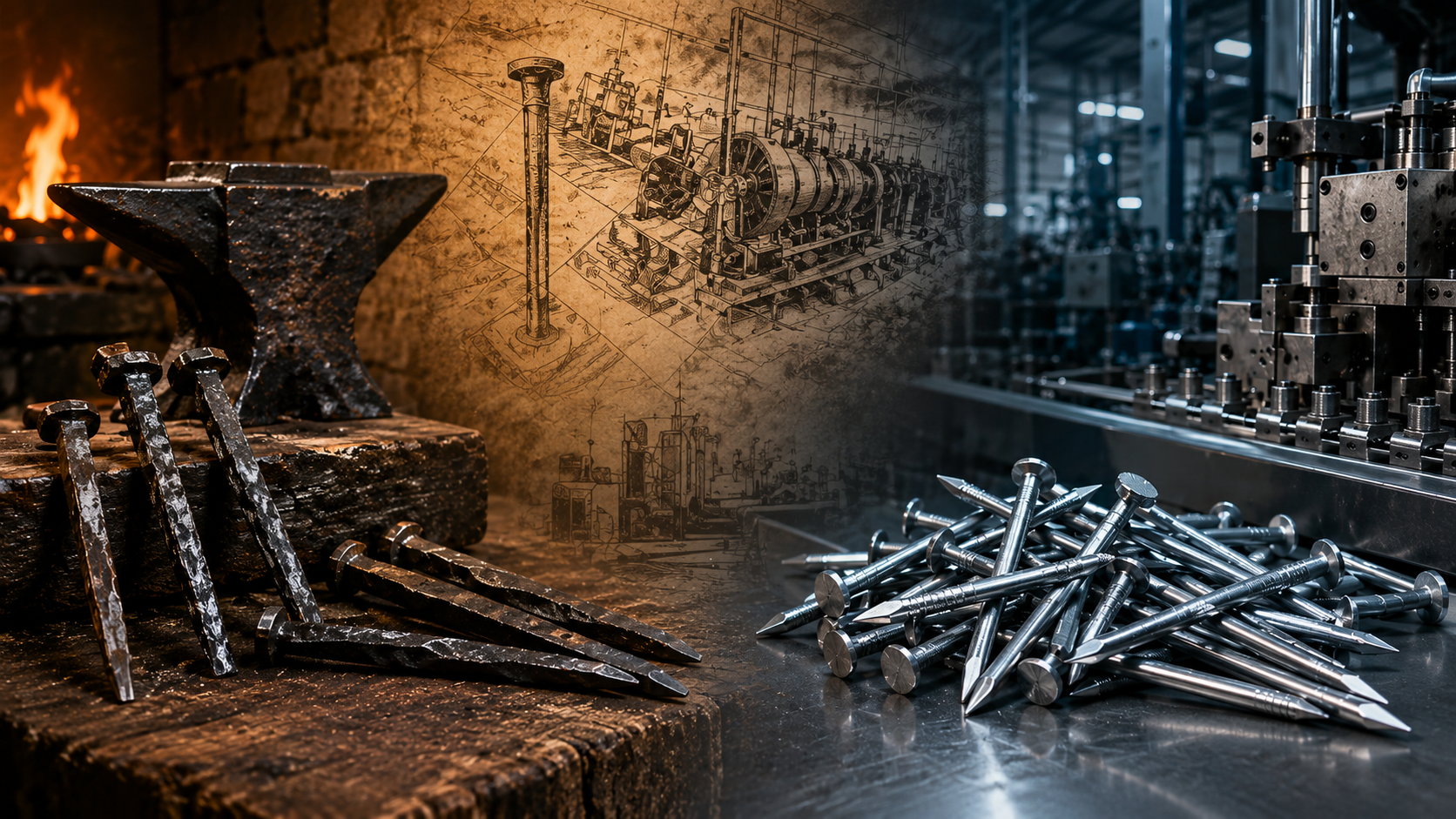
The nail is one of the oldest and most fundamental fasteners in human history. For thousands of years, nails have played an important role in construction, woodworking, packaging, shipbuilding and many other applications. Although a nail may appear to be a very simple product today, the history of nails is closely connected with the development of metalworking, industrialization, mass production and modern manufacturing technologies.
Nails that were once individually forged by skilled craftsmen can now be manufactured by high-speed machines in extremely large quantities and with precise dimensions. So, when were nails first used, how did nail manufacturing develop, and how did modern wire nails become one of the world's most widely used fasteners? Let's explore the evolution of the nail from ancient times to modern industry.
How Far Back Does the History of Nails Go?
The history of nails reaches back to ancient civilizations and the early development of metalworking. Archaeological discoveries show that metal fasteners made from bronze, copper alloys and later iron were used in the ancient world.
Metal nail examples discovered in ancient Egyptian contexts demonstrate that nail-like fasteners were already known many centuries ago. As metalworking techniques improved, nails became stronger and increasingly useful for construction, woodworking, shipbuilding and other applications.
Nails in the Ancient World
Ancient builders did not rely exclusively on metal nails. Wooden pegs, joints, wedges, ropes and other fastening techniques were also widely used. However, improvements in metal production gradually expanded the use of bronze and iron fasteners.
During the Roman period, metal nails became important fasteners in construction and woodworking. Nails could be produced in different lengths, shapes and dimensions depending on their intended use, demonstrating that even early nail designs were influenced by specific application requirements.
The Era of Hand-Forged Nails
Before industrial manufacturing, nail production was largely carried out by blacksmiths and specialist nail makers. Iron rods were heated, hammered into shape, cut to the required length and then headed manually using a hammer and suitable tools.
These products are generally known today as hand-forged nails or wrought nails. Because the manufacturing process depended heavily on the skill of the craftsman, individual nails could vary slightly in size and shape.
Producing nails by hand was labor-intensive. As a result, nails were considerably more costly to manufacture than they are today. The mechanization of nail production therefore became one of the most important developments in the history of the fastener industry.
How Did the Industrial Revolution Change Nail Manufacturing?
During the late 18th and early 19th centuries, advances in manufacturing technology began to transform the nail industry. Instead of forging every nail individually, machinery was developed to cut nails mechanically from metal sheets and strips.
The products associated with this manufacturing method became known as cut nails. Cut nails were manufactured by cutting iron, and later steel, into the required shapes before forming the nail head.
Mechanized nail manufacturing provided several important advantages:
- Production speeds increased significantly.
- Nail dimensions became more standardized.
- Manufacturing costs decreased.
- Large-volume production became possible.
- Nails became increasingly accessible for construction and woodworking.
Nail making gradually evolved from a craft-based activity into an increasingly industrialized manufacturing process.
The Development of Wire Nails
One of the most important developments in modern nail manufacturing was the introduction and widespread adoption of the wire nail. During the 19th century, improvements in metal wire production made it possible to manufacture nails directly from wire instead of cutting them from metal sheets.
The principle was highly effective. Wire was drawn to the required diameter, cut to the appropriate length, formed into a head at one end and pointed at the other. As machinery improved, these operations could be integrated into increasingly fast and automated production processes.
By the late 19th century, steel wire nails were becoming increasingly important. Their suitability for high-speed production, standardized dimensions and cost-effective manufacturing eventually made wire nails one of the foundations of the modern nail industry.
How Are Modern Nails Manufactured?
Today, modern nail manufacturing can be carried out using advanced high-speed and automated production equipment. Although the exact manufacturing process depends on the nail type and application, production generally involves preparing steel wire, forming the nail and applying the necessary finishing processes.
A modern nail manufacturing process may include:
- Preparation of steel wire rod or wire,
- Drawing the wire to the required diameter,
- Cutting the wire to the required nail length,
- Forming the nail head,
- Creating the nail point,
- Forming the required shank geometry,
- Cleaning and polishing,
- Applying coatings or surface treatments when required,
- Quality control, packaging and shipment.
Modern production technology allows manufacturers to produce nails in a wide range of diameters, lengths, head designs, shank geometries and surface finishes with consistent dimensions and quality.
Why Did Different Types of Nails Develop?
The evolution of nails was not limited to improvements in manufacturing technology. Different industries created different performance requirements, leading to the development of specialized nail designs for construction, woodworking, furniture, wooden packaging, pallets, roofing and industrial manufacturing.
Today, many different types of nails are available depending on the application, including:
- Wire nails,
- Construction nails,
- Pallet nails,
- Bulk nails,
- Wire collated nails,
- Plastic collated nails,
- Ring shank nails,
- Nails with different coatings and surface finishes.
The growing use of pneumatic nailers and automated production systems has also increased the importance of collated nails in professional and industrial applications.
From the Hammer to Automated Nailing Systems
The transformation of the nail industry goes beyond the way nails themselves are manufactured. A fastener that was once individually forged by a blacksmith and manually driven with a hammer is now an integral part of highly automated production systems.
In pallet manufacturing, for example, wire collated or plastic collated nails can be used with pneumatic nail guns and automatic pallet production lines. These systems can help increase production speed, reduce manual operation time and improve repeatability in industrial manufacturing.
This transformation demonstrates that the history of nails is also closely connected to the history of manufacturing technology.
From a Simple Fastener to an Industrial Product
The basic concept of the nail has remained remarkably recognizable throughout history: a shank, a point designed to penetrate the material and a head that supports the fastening function. However, the materials, manufacturing techniques, dimensional accuracy, coatings and application technologies associated with nails have changed dramatically.
Modern industrial applications require more than simply joining two pieces of material. Depending on the application, factors such as holding performance, corrosion resistance, dimensional tolerances, compatibility with pneumatic nailers and reliable operation in high-speed production lines can all be important.
The Future of Nails: Efficient and Automated Production
As automation, quality-control technologies and manufacturing efficiency continue to develop, the nail industry continues to evolve as well. Modern factories can combine high-speed production machinery, automated packaging systems and quality-control processes to manufacture large quantities of consistent and reliable products.
At the same time, changing requirements in pallet manufacturing, wooden packaging, construction and other industrial sectors continue to drive the development of nails with specialized shank geometries, coatings and application characteristics.
The Nail: From Ancient History to Modern Industry
From ancient metal fasteners and hand-forged nails to industrial cut nails and today's high-speed wire nail manufacturing, the history of the nail provides a fascinating example of how even the simplest products can evolve alongside technology and industry.
Today, nails remain essential industrial products used in applications ranging from construction and wooden packaging to pallet manufacturing and professional fastening systems.
BEKSAN Nail & Wire combines manufacturing experience with modern production technologies to provide nail solutions for different industrial and professional applications.
To discover more about our nail products, collated nail systems and solutions for professional applications, explore our product range or contact BEKSAN for further information.