
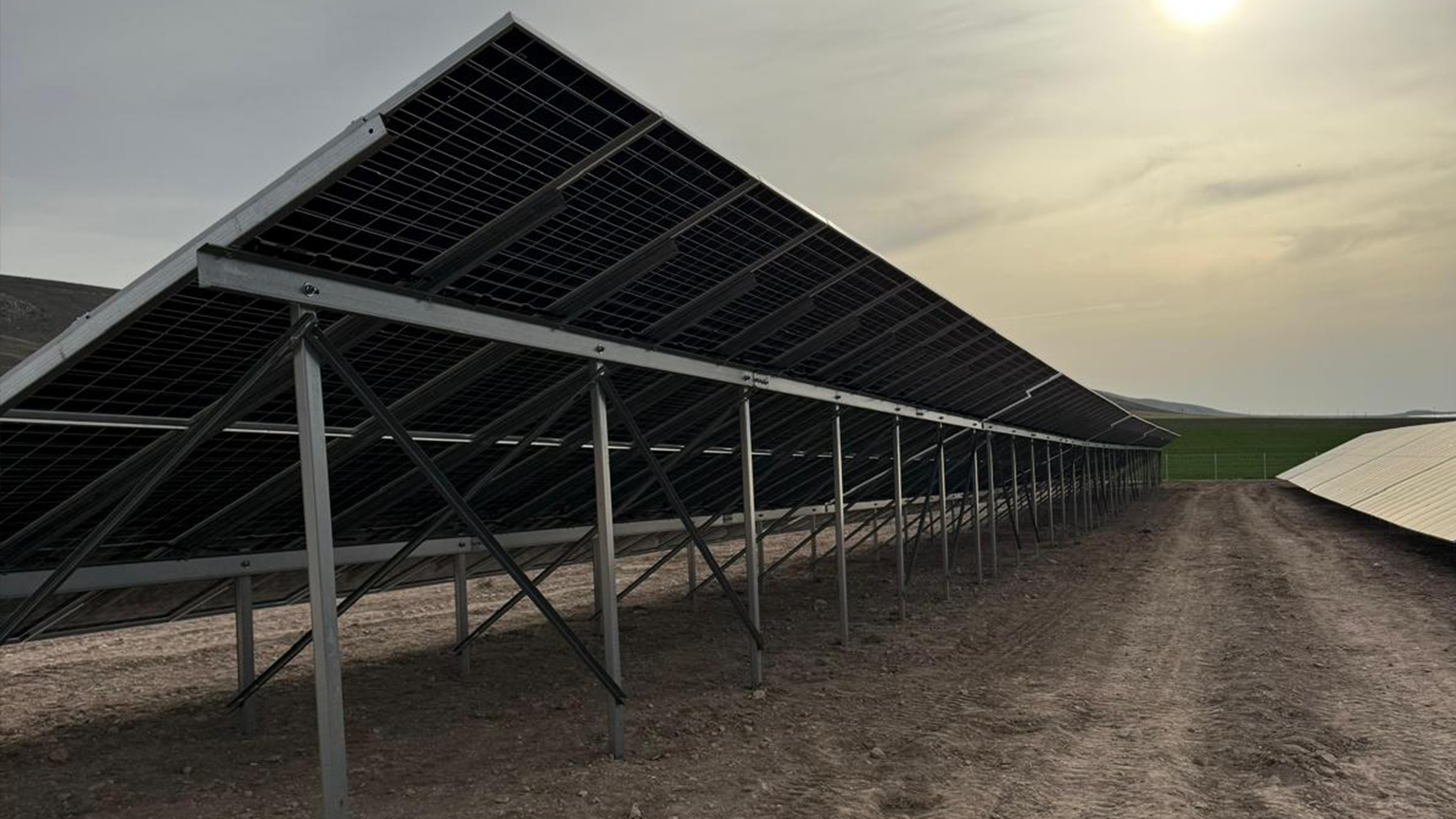
Ground-mounted solar mounting systems are among the most important structural components of medium- and large-scale photovoltaic projects. These systems make it possible to install solar panels securely on open land at the required orientation and inclination while providing long-term structural support under outdoor environmental conditions.
A ground-mounted photovoltaic structure typically consists of supporting profiles, posts, purlins, braces, fasteners and project-specific structural components. The design should take into account soil conditions, project capacity, solar panel dimensions, wind and snow loads, terrain geometry and local environmental conditions.
In this guide, we explore ground-mounted solar mounting systems, their main components, foundation options, applications and the most important factors to consider when selecting a structural solution for a photovoltaic power plant.
What Is a Ground-Mounted Solar Mounting System?
A ground-mounted solar mounting system is a structural framework designed to support photovoltaic panels directly on open land.
Its main purpose is to securely support solar panels, position them at the required orientation and tilt angle and provide structural resistance throughout the lifetime of the photovoltaic installation.
Ground-mounted systems are particularly common in large solar power plants, where hundreds or thousands of photovoltaic modules can be installed in organized rows across large areas.
What Components Are Used in Ground-Mounted Solar Systems?
The exact components vary according to project requirements, but a typical ground-mounted structure may include:
- Ground posts,
- C and U profiles,
- Purlins and supporting rails,
- Bracing elements,
- Solar panel rails,
- Connection plates,
- Bolts and nuts,
- Module clamps,
- Foundation and ground connection components.
All of these components should be selected according to structural calculations, module arrangement and site conditions.
How Are Ground-Mounted Solar Structures Connected to the Ground?
One of the most important design considerations in ground-mounted photovoltaic projects is the method used to anchor the structure to the soil.
Different foundation solutions can be selected depending on geotechnical conditions and engineering requirements.
1. Driven Pile Solar Mounting Systems
In a driven pile solar mounting system, specially designed steel profiles are driven directly into suitable ground using pile-driving equipment.
Under appropriate soil conditions, this method can provide fast installation and reduce the need for concrete foundations.
Profile geometry, penetration depth and load capacity should be determined through soil investigations and engineering calculations.
2. Screw Pile Systems
Some projects may use screw piles or helical foundation solutions. These components are installed into the soil by rotational movement.
Depending on the ground conditions, screw pile solutions can offer advantages such as relatively fast installation, limited excavation and potential removability.
3. Concrete Foundations
When soil conditions are unsuitable for driven piles or screw foundations, concrete foundation solutions may be considered.
Structural posts can be connected to reinforced concrete foundations using anchor systems. The foundation design should take into account structural loads, soil bearing capacity and environmental conditions.
Where Are Ground-Mounted Solar Systems Used?
Ground-mounted solar structures can be used in photovoltaic projects of different sizes.
Typical applications include:
- Utility-scale solar power plants,
- Industrial ground-mounted PV projects,
- Agricultural solar energy installations,
- Energy community and cooperative projects,
- Municipal and public-sector solar projects,
- Commercial and private photovoltaic investments.
Where sufficient land is available, ground-mounted systems offer considerable flexibility in optimizing module orientation and tilt.
The Importance of Ground-Mounted Structures in Utility-Scale PV Projects
In large solar power plants, the mounting structure can significantly influence construction efficiency and project execution.
Projects involving thousands of solar panels require structural systems that can be manufactured efficiently, transported economically and assembled quickly in the field.
Consistent profile dimensions, accurately positioned connection holes and installation-friendly designs can therefore provide important advantages in large-scale project management.
How Does Terrain Slope Affect the Solar Mounting Structure?
Solar power plants are not always built on perfectly flat sites. Terrain can include slopes, elevation differences and irregular geometries.
Terrain conditions may affect:
- Post lengths,
- Panel row arrangement,
- Mounting height,
- Row spacing,
- Internal access and service roads.
For this reason, structural design should consider both module dimensions and the topographical characteristics of the project site.
Why Is Wind Load Important?
Solar panels have relatively large surface areas and can therefore experience significant wind forces, particularly on open land.
As a result, wind load is one of the key engineering factors in ground-mounted solar structure design.
Panel height, tilt angle, row configuration, site location and regional wind conditions should all be considered during structural calculations.
How Does Snow Load Affect a Solar Structure?
In regions with heavy snowfall, accumulated snow can create additional loads on photovoltaic modules and their supporting structures.
The profiles and structural components should therefore be designed to provide adequate resistance to the expected snow loads.
Local climate data, module inclination and structural geometry should all be included in the engineering design.
Solar Panel Tilt in Ground-Mounted Systems
One of the major advantages of ground-mounted photovoltaic systems is the ability to optimize module orientation and tilt angle according to project requirements.
Important factors include:
- Geographic location,
- Solar irradiation,
- Terrain characteristics,
- Row spacing,
- Shading conditions,
- Wind and snow loads.
A properly optimized module arrangement can contribute to the overall energy performance of the solar power plant.
Why Is Row Spacing Important?
Photovoltaic modules in ground-mounted systems are normally arranged in multiple rows. If the rows are positioned too close together, one row may shade another when the sun is at a lower angle.
On the other hand, excessive spacing can reduce the efficient use of available land.
The appropriate distance between rows should therefore be optimized according to module height, module tilt, solar angles and site conditions.
C and U Profiles in Ground-Mounted Solar Structures
C and U profiles are widely used structural components in ground-mounted solar mounting systems.
Roll-formed profiles can be manufactured in different cross-sectional geometries, lengths and perforation configurations according to project requirements.
Important design considerations include:
- Structural load,
- Profile span,
- Material grade,
- Material thickness,
- Connection points,
- Corrosion protection.
Advantages of Roll Forming Technology
Profiles used in large ground-mounted solar projects often need to be produced in significant quantities while maintaining consistent dimensions. Roll forming technology is well suited to this requirement.
During roll forming, long steel strips pass through a sequence of forming rolls until the required cross-sectional geometry is achieved.
Potential advantages include:
- High production capacity,
- Repeatable profile geometry,
- Consistent dimensional tolerances,
- Project-specific cross sections,
- Suitability for high-volume manufacturing.
Corrosion Resistance in Ground-Mounted Solar Systems
Ground-mounted solar structures remain exposed to rain, moisture, snow, sunlight and temperature variations throughout the year.
Steel profiles and fasteners therefore require appropriate protection against corrosion.
Depending on site conditions and project requirements, galvanized steel or alternative protective surface systems may be selected. Appropriate corrosion protection can significantly influence the long-term service life and maintenance requirements of the mounting structure.
Ease of Installation in Ground-Mounted PV Projects
For large photovoltaic projects, structural strength is not the only important consideration. Installation efficiency also plays a major role.
Profiles with pre-engineered holes and connection points can reduce the amount of field processing required and help shorten installation time.
The use of standardized structural components can also contribute to more organized site operations and reduce installation errors.
What Should Be Considered When Selecting a Ground-Mounted Solar System?
Selecting a solar mounting system should not be based solely on the price of the structural profiles. The complete system should be evaluated throughout the expected project lifetime.
Important considerations include:
- Terrain and soil conditions,
- PV project capacity,
- Solar module dimensions and weight,
- Wind and snow loads,
- Module orientation and tilt angle,
- Profile and material specifications,
- Corrosion resistance,
- Foundation method,
- Installation time and simplicity,
- Transport and logistics,
- Maintenance requirements.
Advantages of Ground-Mounted Solar Mounting Systems
When properly designed for suitable site conditions, ground-mounted systems can offer several advantages:
- Ability to develop large-capacity photovoltaic plants,
- Flexible optimization of module orientation and inclination,
- Easy access for maintenance and cleaning,
- Compatibility with different foundation solutions,
- Scalable modular designs,
- Suitability for high-volume field installation.
BEKSAN Ground-Mounted Solar Mounting Systems
BEKSAN Solar Mounting Systems provides structural profile and mounting solutions for ground-mounted photovoltaic projects.
With roll forming manufacturing capabilities, C and U profile solutions can be developed according to project-specific structural requirements, including profile geometries, perforation patterns and connection details.
Monitoring dimensional accuracy, profile geometry, connection details and surface quality during manufacturing contributes to the development of reliable and installation-friendly solar mounting solutions.
For more information about ground-mounted solar mounting systems, PV structures, driven pile applications, C/U profiles and solar panel supporting systems, contact BEKSAN Solar Mounting Systems.